Roulette Bets Explained: Inside and Outside Bets
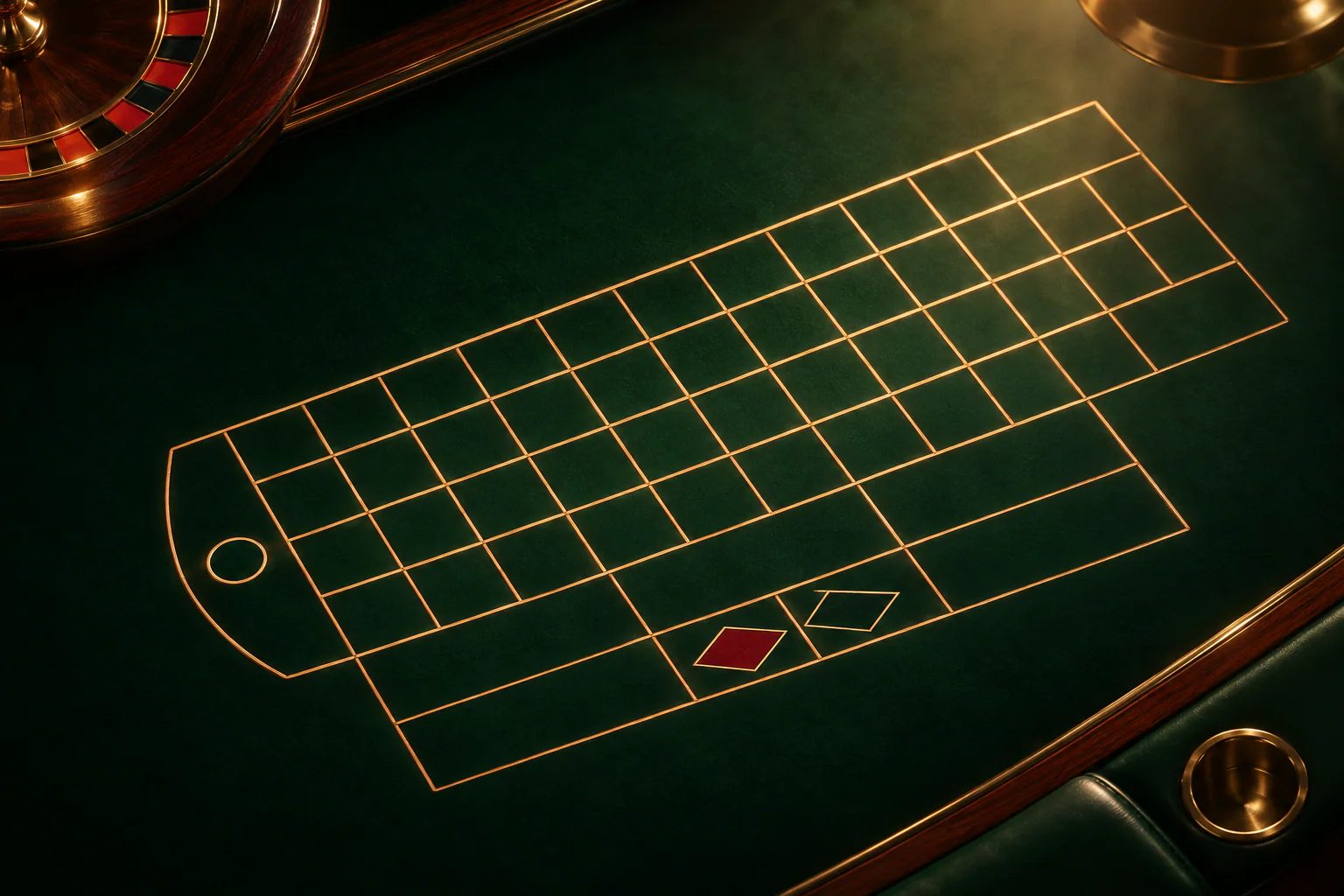
Roulette bets explained simply: every bet on the table is either an inside bet, placed on the numbers themselves, or an outside bet, placed in the boxes around them that cover larger groups. Inside bets cover fewer numbers and pay more; outside bets cover more numbers and pay less. Every bet that covers the winning number is paid, and the chip you placed comes back as well.
The table below lists every standard bet. The sections after it show where each chip goes.
Roulette bets explained in one table
| Bet | Numbers covered | Pays |
|---|---|---|
| Straight up | 1 | 35 to 1 |
| Split | 2 | 17 to 1 |
| Street | 3 | 11 to 1 |
| Corner | 4 | 8 to 1 |
| Six line | 6 | 5 to 1 |
| Dozen | 12 | 2 to 1 |
| Column | 12 | 2 to 1 |
| Red or black | 18 | 1 to 1 |
| Odd or even | 18 | 1 to 1 |
| Low (1-18) or high (19-36) | 18 | 1 to 1 |

Inside bets
Inside bets sit on the grid of numbers.
Straight up
One chip entirely inside the square of one number. It is the bet with the highest payout on a standard table.
Split
A chip on the line between two numbers that touch, either side by side or one above the other, such as 14 and 17 or 8 and 9.
Street and six line
A street covers a row of three numbers, such as 7, 8 and 9, with the chip on the outer edge of the row. A six line, also called a double street, covers two rows next to each other, such as 31 to 36, with the chip on the corner where the two rows meet the edge.
Corner
A chip on the point where four numbers meet, such as 10, 11, 13 and 14.
Bets with the zero
The zero sits at the top of the grid, and a few bets include it. A trio, sometimes called a basket, covers three numbers including a zero, such as 0, 1 and 2. On a single-zero table the first four covers 0, 1, 2 and 3. On a double-zero table the top line covers 0, 00, 1, 2 and 3.
Outside bets
Outside bets sit in the boxes along the bottom and side of the grid.
- Red or black: every number of the chosen colour.
- Odd or even: every odd or every even number. Zero counts as neither.
- Low or high: 1 to 18, or 19 to 36.
- Dozens: 1 to 12, 13 to 24 or 25 to 36.
- Columns: one of the three vertical columns of twelve numbers on the layout.
Except where a table has a special rule, every outside bet loses when the ball lands on zero. Some French tables return half of an even-money stake on zero instead; French roulette rules explains La Partage and En Prison.
A few casinos also offer the snake bet, which follows a zig-zag of twelve red numbers from 1 to 34 and pays the same as a dozen.
A closer look: why the payouts fit together
Each payout is set as if the wheel had 36 numbers. A split covers 2 of 36, so it pays 17 to 1: win once in 18 spins and you get back 17 units plus the stake, 18 in all, which is exactly what you staked over those spins. A street covers 3, so 11 to 1; a corner 4, so 8 to 1. The pattern holds all the way to the even-money bets.
The wheel, though, has 37 pockets on a European table and 38 on an American one. The extra green pocket is why every bet loses a little over time, and why the edge is the same for every standard bet on the same wheel. Roulette odds and payouts works the numbers through, and roulette betting systems explains why no mix of bets changes them.
Checklist for trying bets in a free demo
- Place one chip of each kind and read the payout the game shows when you hover or tap.
- Check whether the table has a first four or a top line bet near the zero.
- Find the racetrack, if there is one, for bets on neighbouring numbers; call bets in roulette covers those.
- Watch a zero land and see which bets lose.
The classic roulette demos are a good place to start, because they keep only the standard bets.
Related reads
- How to play roulette: one full round from start to finish.
- European vs American roulette: one extra pocket and what it costs.
- Roulette wheel numbers: the order and colours on the wheel.
More in Roulette Bets · Report a correction
Related reading

Call Bets in Roulette: Voisins, Tiers and Orphelins
Call bets in roulette cover slices of the wheel rather than the table: Voisins du Zéro, Jeu Zéro, Tiers du Cylindre, Orphelins and neighbours bets explained.

Is Online Roulette Random? How RNG Roulette Works
Is online roulette random? How a computer roulette table picks its number, what the UK's technical standards require and what free demos must match.

Lightning Roulette Explained: Lucky Number Multipliers
Lightning Roulette explained: the live game that strikes one to five lucky numbers with multipliers from 50x to 500x, how a round runs and its RNG cousins.